
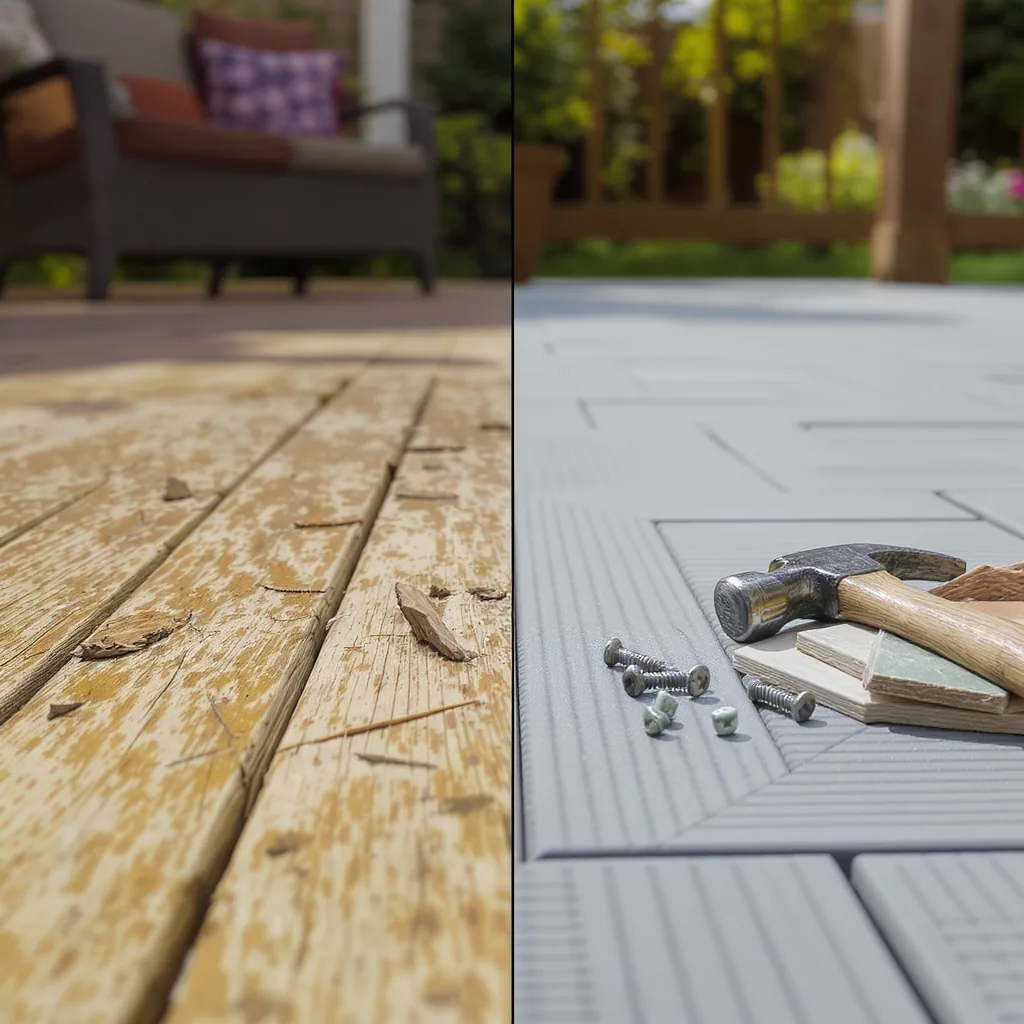
Deck and Patio Surfaces: Repairing Wood vs Composite Materials
The degradation of an exterior deck or patio surface presents a significant technical and financial decision point for property owners. Confronted with visible wear, rot, or structural concerns, the core dilemma is whether to execute a comprehensive repair of the existing wood structure or to undertake a full surface replacement with modern composite materials. This choice extends far beyond cosmetic appeal, demanding an analysis grounded in material science, failure mode diagnostics, and projected lifecycle performance.
This guide provides a method-driven framework for this evaluation, aligning with industry standards from ASTM and the American Wood Protection Association (AWPA). The objective is to move from anecdotal preference to a defensible decision based on the existing structure’s integrity, a comparative analysis of total cost of ownership over a 15-year horizon, and a clear understanding of the long-term maintenance liabilities inherent to each material system.
Foundational Analysis: Material Properties and Failure Modes
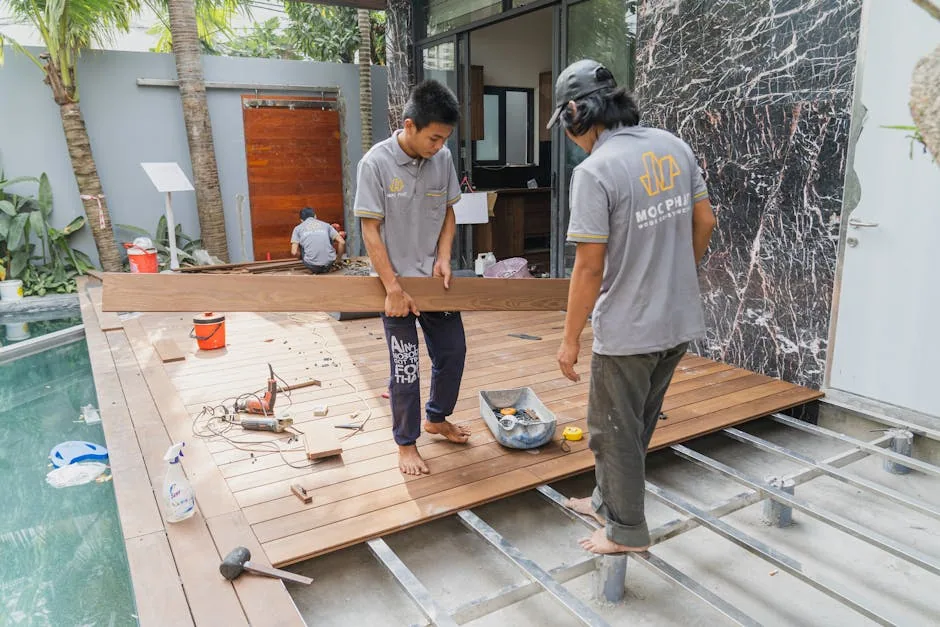
Photo by CÔNG TY CP THI CÔNG MỘC PHÁT on Pexels
Before evaluating repair or replacement, a technical understanding of the core materials is essential. This analysis is grounded in material science and standardized testing protocols, primarily from the American Society for Testing and Materials (ASTM). These standards, such as ASTM D7032 for wood-plastic composites, provide a controlled framework for comparing performance attributes like durability, mechanical strength, and weatherability. The fundamental divergence between wood and composite lies in their composition and, consequently, their inherent failure modes.
Traditional wood decking, typically pressure-treated Southern Yellow Pine or naturally durable species like cedar, is an anisotropic, hygroscopic material. Its performance is governed by its cellular structure and the efficacy of its preservative treatment, which must meet standards set by the American Wood Protection Association (AWPA). Wood’s primary vulnerabilities are biological decay and dimensional instability. Decay fungi require moisture, oxygen, and a food source (the wood cellulose), making any scenario where wood moisture content remains above 20% for prolonged periods a high-risk condition. Insect infestation, particularly from subterranean termites or carpenter ants, is another biological failure mode. Dimensional instability manifests as cupping, warping, and checking as the wood absorbs and releases moisture from the environment, a cycle driven by changes in relative humidity and direct wetting.
In contrast, composite decking is a manufactured material, typically comprising a blend of wood flour or cellulose fibers and thermoplastic polymers like polyethylene or polyvinyl chloride. This engineered composition is designed to eliminate the primary food sources for biological decay. A critical differentiator in composite quality is the presence and thickness of a polymer “cap.” A full-profile cap, where the protective polymer layer extends the full thickness of the board, offers superior resistance to moisture ingress and fading compared to a thin co-extruded layer. However, composites introduce different engineering considerations. Their thermal expansion and contraction rate is significantly higher than wood’s—a factor that must be meticulously accounted for in installation gapping. Furthermore, while resistant to rot, composites have distinct mechanical properties; their flexural strength (modulus of rupture) and stiffness (modulus of elasticity) differ from wood, directly influencing maximum allowable joist spacing. A common failure signal for improperly supported composites is a perceptible “bounce” or sag between joists.
The choice between repairing wood and replacing with composite often hinges on which set of failure modes is more manageable for the homeowner. Wood failure is often localized and repairable but recurrent if environmental conditions aren’t corrected. Composite aims for systemic, long-term resistance but requires precise installation to manage its unique physical behaviors. For authoritative guidance on material selection and properties, consulting the USDA Forest Products Laboratory publications provides a scientifically rigorous foundation.
The Wood Repair Pathway: Methodical Assessment and Execution
Proceeding with wood repair is a viable strategy only after a systematic, evidence-based assessment confirms the damage is localized and the underlying structure is sound. This pathway is not a cosmetic fix but a structural remediation that must address both symptom and root cause. The assessment protocol should be methodical, moving from the deck’s attachment to the house outward to its surface.
The first and most critical inspection point is the ledger board. This is the single most common point of catastrophic deck failure due to water intrusion and improper fastening. Examine the ledger-to-house connection for proper flashing (a metal or membrane layer that directs water away from the house) and for corrosion of lag screws or bolts. Probe the ledger and the house band joist behind it with an awl or screwdriver; soft, spongy wood indicates advanced rot. Next, assess the structural framing: joists, beams, and posts. Use a moisture meter on multiple joist tops; readings consistently above 18-20% signal a high-risk environment for decay. Visually inspect for fungal growth, dark staining, or cross-grain cracking. The “probe test” is definitive: force a sharp, narrow tool like an ice pick or ¼” drill bit into the wood. If it penetrates more than ¼” with minimal resistance, the wood has lost its structural integrity. Document the linear feet of joist that require “sistering” (reinforcing with a new joist alongside the old) or full replacement.
Finally, evaluate the deck boards. Calculate the percentage of boards showing advanced cupping, severe checking, splintering, or rot. A practical threshold for considering repair over full replacement is when less than 30% of the decking requires swapping. Damage concentrated near railings, planters, or other water-trapping details is a strong indicator of the root cause: poor water management.
The execution of repairs must follow a disciplined sequence. First, remedy the water source. This may involve installing new code-compliant flashing at the ledger, regrading soil for positive drainage away from posts, or ensuring adequate under-deck ventilation. Structural repairs come next. Sistering a joist requires the new pressure-treated lumber (stamped UC4B or better for ground contact) to be at least as long as the damaged section and securely fastened with structural screws or bolts through both members. Deck board replacement requires careful extraction to avoid damaging adjacent sound boards. Use only corrosion-resistant fasteners—hot-dipped galvanized or, preferably, stainless-steel screws—and follow the recommended fastening pattern, typically screwing down through the face near the board ends and into the joist center. A critical best practice is to apply a penetrating water-repellent sealant to the cut ends and any drilled holes of new pressure-treated wood before installation, as these are the most vulnerable points for moisture ingress.
The Composite Replacement Pathway: Substrate Preparation and Installation Standards
Opting for composite replacement is not merely a surface-level upgrade; it is a system transition that demands the existing substrate be brought to a higher standard. The most frequent cause of composite deck performance issues is improper installation onto an inadequate frame. Therefore, the process begins with a forensic evaluation and potential reconstruction of the underlying structure, treating the old frame as a template rather than a finished product.
The initial step is a structural verification. The existing joists, beams, and posts must be evaluated using the same rigorous probe and moisture meter tests described in the wood repair pathway. However, the acceptance criteria are stricter. Any joist with compromised integrity must be replaced, not sistered, as composite materials often require tighter joist spacing (frequently 12 inches on-center versus 16 inches for wood). The entire frame must be brought to a true plane, free of high or low spots exceeding 1/8 inch over a 4-foot span, to prevent visible undulations in the rigid composite boards. This may involve planing down high joists or adding shims to low ones, though replacing the joist is often more reliable.
Substrate preparation is paramount. After ensuring the frame is sound, straight, and correctly spaced, a secondary layer is often recommended. Installing a plastic or composite drainage mat (sometimes called a “joist protection tape”) over the tops of all joists serves two critical functions: it prevents moisture trapping between the composite and the wood, and it reduces thermal transfer. Furthermore, ensuring a minimum 18-inch clearance from the ground to the bottom of the joists promotes essential airflow to keep the wooden substructure dry, a standard supported by building code best practices.
Installation execution must adhere precisely to the manufacturer’s technical literature. Two non-negotiable specifications are gapping and fastening. End-to-end gaps (between board ends) and side-to-side gaps (between board edges) are specified to accommodate thermal expansion, which for composites can be 2-3 times greater than for wood. These gaps, typically between 1/8 and 1/4 inch, are not aesthetic suggestions but engineering requirements to prevent buckling. Fastener choice is equally critical. Most composite systems require proprietary hidden clip systems that allow for expansion and contraction. Using incorrect screws or over-driving face screws can create stress points and void the product’s warranty. The entire installation process, from the first board to the last, must be guided by the principle that composite is a precision-engineered product installed as a system, where deviation from protocol introduces a quantifiable risk of premature failure.
Technical and Performance Comparison: Wood vs. Composite
A direct, attribute-by-attribute comparison clarifies the operational and long-term implications of each material choice. The following table synthesizes key performance criteria, providing concrete anchors for decision-making. It is important to note that “composite” represents a category with a performance range; values given are for mid-to-high-tier capped composite products.
| Attribute | Pressure-Treated Wood | Capped Composite Decking |
|---|---|---|
| Core Composition | Solid wood (e.g., Southern Yellow Pine) with preservative chemicals (e.g., micronized copper). | Wood-plastic composite (WPC) or plastic lumber with a polymer cap layer. |
| Primary Failure Modes | Rot, fungal decay, insect infestation, warping/cupping, fastener corrosion, splintering. | Thermal expansion/contraction issues, surface staining (if uncapped), fading over time, mold/mildew on surface (not structural). |
| Key Mechanical Property (Flexural Strength) | High, but variable. Modulus of Rupture (MOR) ~8,500-10,000 psi. | Lower than wood. MOR ~2,500-4,500 psi, necessitating tighter joist spacing. |
| Moisture Absorption | High (hygroscopic). Can absorb >25% moisture by weight, leading to swelling and decay. | Very low (<1% for capped products). Resists internal moisture damage. |
| Thermal Expansion Coefficient | Low. Approximately 0.000002 in/in/°F along the grain. | High. Approximately 0.00004 to 0.00006 in/in/°F, requiring precise gapping. |
| Surface Temperature in Sun | Moderate. Lighter colors stay cooler; dark stains absorb more heat. | Can be significantly hotter than wood, especially in darker colors. Some products have “cool deck” technology. |
| Required Maintenance Cycle | Annual cleaning, inspection, and reapplication of water-repellent sealant every 2-3 years. | Semi-annual cleaning with soap and water to prevent surface mold/mildew. No sealing required. |
| Expected Service Life (Surface) | 10-15 years with diligent maintenance before significant board replacement is needed. | 25-30+ years based on warranty periods for fade and stain resistance; structural life depends on substrate. |
| Installation Flexibility | High. Can be cut, routed, and fastened with standard tools; forgiving of minor substrate imperfections. | Moderate. Requires specific tools (hidden fastener system, specialized saw blades), strict adherence to spacing and substrate specs. |
The table reveals a fundamental trade-off: wood offers superior mechanical strength and installation forgiveness but carries a high and recurring maintenance burden to manage its biological vulnerabilities. Composite sacrifices some rigidity and requires meticulous installation but provides long-term resistance to decay and a dramatically reduced maintenance profile. The decision point often rests on whether an owner is prepared to invest time and resources proactively (wood) or prefers to allocate capital upfront to minimize future time and material inputs (composite).
Lifecycle Cost Analysis: Modeling the 15-Year Financial Horizon
The most common analytical error in the repair-versus-replace decision is focusing solely on initial cost. A technically sound decision requires a lifecycle cost analysis (LCA) that projects total ownership expenses over a meaningful timeframe, such as 15 years. This model must include direct material and labor costs, indirect owner labor, and probabilistic costs for future repairs.
Begin by establishing two detailed cost baselines. For Wood Repair, the quote must be comprehensive: cost of new pressure-treated boards, replacement joists, fasteners, sealant, and all labor for demolition, prep, and installation. Crucially, add a line item for correcting the root cause (e.g., new flashing, drainage work). For Composite Replacement, the quote should include: removal/disposal of old decking, any necessary joist replacement/repair to meet spacing specs, the composite boards, the proprietary hidden fastener system, and all installation labor.
Next, build the 15-year cost projection. For the wood repair scenario, model recurring costs:
- Maintenance Labor & Materials: Factor 4 hours of owner labor or professional service cost for annual cleaning and inspection. Add material cost for a high-quality water-repellent sealant applied every 3 years (5 applications over 15 years).
- Probabilistic Repair: Based on failure rates, allocate a 20-30% probability of needing to replace an additional 10% of deck boards within the 15-year window due to new rot or warping. Include this as a weighted cost.
For the composite replacement scenario, the ongoing costs are lower but not zero:
- Maintenance Labor: Factor 2 hours of owner labor for semi-annual cleaning (soap and water only). No material costs for sealants.
- Probabilistic Repair: The risk of board failure is very low but non-zero. Allocate a <5% probability of replacing a single damaged board due to extreme impact or manufacturing defect.
When these future costs are discounted and added to the initial investment, a clear financial picture emerges. A typical analysis shows that while the initial composite replacement cost may be 40-60% higher than a comprehensive wood repair, the cumulative cost curves often cross between years 7 and 10. By year 15, the total cost of ownership for the diligently maintained wood deck frequently meets or exceeds that of the composite deck. This model validates the “70% Rule”: if a full wood repair costs more than 70% of a composite replacement, the composite option is almost always the superior financial choice over a 15-year horizon, as it purchases decades of additional service life and reduced labor.
Decision Matrix: Applying Technical Criteria to Your Project
Synthesizing the preceding technical and financial analyses yields a deterministic decision algorithm. This matrix uses clear, binary criteria to guide homeowners toward a defensible choice. The process begins with the structural assessment and cost quotes outlined earlier.
Choose the Wood Repair Pathway IF the following conditions are ALL met:
- Damage is Localized: The percentage of deck boards requiring replacement is less than 30%. Joist damage is confined to short, accessible sections suitable for sistering (less than 20% of total joist length).
- Substrate Integrity is High: Moisture meter readings on remaining structural members are consistently below 18%. Probe tests reveal solid wood in at least 95% of the ledger, joists, beams, and posts.
- Root Cause is Correctable: The source of moisture (failed flashing, poor grade, lack of ventilation) can be identified and permanently remedied with standard construction techniques.
- Cost Ratio is Favorable: The total cost of the comprehensive repair (including root cause correction) is less than 60% of the cost to replace with composite.
- Owner Commitment is Present: There is a demonstrated willingness and ability to perform or fund the required annual maintenance cycle for the life of the deck.
Choose the Composite Replacement Pathway IF ANY ONE of the following conditions is TRUE:
- Damage is Widespread: Over 30% of deck boards are unsalvageable, or joist damage is extensive, requiring replacement of more than 20% of joist length.
- Substrate is Compromised: The structural frame has widespread high moisture content (>20%) or rot, indicating a systemic moisture problem that rebuilding upon is risky.
- Cost Ratio Threshold is Exceeded: The total cost of a full wood repair exceeds 70% of the composite replacement cost. This is the primary economic trigger.
- Maintenance Tolerance is Low: The owner’s priority is minimizing future time, labor, and uncertainty associated with wood maintenance, justifying a higher capital outlay.
- Long-Term Value is a Priority: For a property intended to be held for 10+ years, the enhanced longevity, warranty, and curb appeal of a new composite surface provide a better return on investment.
This matrix eliminates ambiguity. It forces the decision away from gut feeling and toward verifiable conditions and quantified thresholds. The final step is to align the technically indicated choice with project budget and personal preference, but with the full understanding of the long-term implications each path entails.
Common Technical and Strategic Oversights
Even with a sound decision framework, execution errors can undermine the investment. These oversights typically stem from a lack of systems thinking, focusing on the component rather than the integrated assembly.
Mistake 1: Treating surface symptoms only (e.g., just replacing rotten boards) without diagnosing and remedying the underlying moisture source (failed flashing, poor drainage, ground contact).
Consequence: Recurring decay in adjacent wood within 2-3 years, leading to wasted repair investment. The new boards will succumb to the same environmental conditions that damaged the old ones.
Prevention: Conduct a full water management audit during inspection. Correct all drainage paths, install proper flashing per IRC code, and ensure a minimum 6-inch clearance from the ground to the bottom of the structural wood.
Mistake 2: Installing composite decking directly onto an old, uneven, or improperly spaced wooden substrate.
Consequence: Violation of manufacturer’s warranty, visible sagging or bouncing, excessive thermal expansion leading to board buckling, and premature fastener failure. The composite material’s performance is contingent on a perfectly prepared frame.
Prevention: Treat the existing frame as a structural template only. Plan to replace any questionable joists and add blocking. Verify and adjust joist spacing to the exact specification of the composite product (often 12″ on-center), which may require adding new joists between existing ones.
Mistake 3: Using cost-per-board-foot as the primary decision metric, ignoring lifecycle labor and material costs.
Consequence: Selecting the apparently cheaper option (wood repair) which, when future maintenance is accounted for, becomes more expensive than composite within a decade. This is a classic error in net present value calculation.
Prevention: Use the provided lifecycle cost model. Solicit quotes that include all labor for repair/prep and factor in your own time or cost for future maintenance activities. The most accurate quotes will be itemized, allowing you to see where costs are allocated.
The Tradeoff
The decision to repair a wood deck or replace it with composite is fundamentally a technical investment analysis with defined, consequential trade-offs. The wood repair pathway offers a lower initial capital requirement but binds the owner to a predictable, recurring cycle of inspection, cleaning, and protective treatments—a commitment of both time and future material costs. In contrast, the composite replacement pathway demands a significant upfront financial outlay but purchases a substantial reduction in annual maintenance labor and material uncertainty, effectively front-loading the cost of ownership.
There is no universally correct answer, only a technically justified one specific to your deck’s condition, your financial horizon, and your operational priorities. The most defensible choice emerges not from preference alone, but from the disciplined application of the assessment protocol, the lifecycle cost model, and the decision matrix. By anchoring the decision in material standards, failure mode analysis, and total cost of ownership, you move beyond a simple repair/replace dilemma to making a strategic, long-term investment in your property’s value and your own time.
Key Technical Takeaways
- The 60-70% Cost Threshold is Critical: When the total cost of a comprehensive wood repair (including hidden structural fixes) exceeds 60-70% of a full composite replacement, replacement becomes the economically rational default choice over a 15-year horizon.
- Wood’s Repairability is Conditional: Wood repair is a high-value strategy only for localized damage (typically <30% of boards) on a structurally sound, dry substrate, and it necessitates a committed, proactive maintenance regimen to manage its inherent susceptibility to biological decay.
- Composite is a System, Not Just a Surface: Successful composite replacement is a system upgrade. Its performance and warranty compliance depend entirely on strict adherence to manufacturer specifications for substrate preparation, joist spacing, and fastener installation.
- Lifecycle Cost Reveals the True Economics: A 15-year total cost of ownership model, incorporating initial costs, maintenance labor, and probabilistic repairs, consistently shows that composite’s higher upfront cost is offset by lower long-term expenditures, particularly for owners who value low maintenance.
- Root Cause Correction is Non-Negotiable: Whether repairing or replacing, the fundamental cause of failure—almost always related to water management (flashing, drainage, ventilation)—must be diagnosed and permanently corrected to ensure the longevity of the investment.
Frequently Asked Questions
Can composite decking be repaired if a single board is damaged, or does the whole section need replacement?
Yes, individual composite boards can typically be replaced, but the process is more involved than with wood. It requires removing the fascia board (if present) and sequentially deconstructing the deck from the edge back to the damaged board, as most hidden fastener systems lock boards together. This is why precision during initial installation to avoid damage is crucial. Some manufacturers offer replacement services or specific tools for this purpose.
What is the most reliable method to test for hidden rot in wood joists and beams during an assessment?
The most reliable field method is a combination of visual inspection, moisture metering, and the probe test. After checking for visual cues (dark stains, fungal growth), use a pin-type moisture meter on multiple points of a joist. Readings above 20% warrant further investigation. Then, use a sharp, narrow tool like an ice pick or a 3/16″ drill bit. Apply moderate pressure to the wood, especially in areas near fasteners or where joists meet beams. If the tool penetrates the wood more than 1/4 inch with little resistance, the wood has lost its structural integrity due to decay.
How does the thermal expansion of composite materials affect installation and gapping requirements compared to wood?
Composite materials have a coefficient of thermal expansion 2 to 3 times greater than wood. This means they expand and contract more with temperature fluctuations. To accommodate this, manufacturers specify precise gap sizes at installation. These include a gap between the deck board ends (typically 1/8″ to 1/4″) and a gap between the board edge and a fixed object like a house or railing (often 3/8″ to 1/2″). Failure to leave these gaps, especially in full sun, can cause boards to buckle or push against each other, damaging the fastening system and creating an uneven surface.
Are there specific building code considerations or permits required when switching from a wood to a composite deck surface?
The permit requirement is usually triggered by structural changes, not the surface material itself. If you are only replacing deck boards on an existing, code-compliant frame, a permit may not be required. However, if the composite replacement necessitates altering the joist structure (e.g., adding joists to achieve 12″ on-center spacing), you are modifying the building’s structure, which typically requires a permit and inspection. Always check with your local building department. Furthermore, the composite deck must still meet all applicable codes for live load (40+ psf), railing height (36″ minimum), and stair geometry.
What are the realistic lifespan expectations for a professionally repaired wood deck versus a new composite deck, based on industry data?
A professionally repaired wood deck, where all rot is removed, the root cause is fixed, and a rigorous maintenance schedule is followed, can have a renewed surface lifespan of 10-15 years before significant board replacement is again needed. The underlying repaired structure may last longer. A new composite deck, installed to manufacturer specifications on a properly prepared substrate, has a surface lifespan often warranted for 25-30 years against fading and staining. The structural lifespan is contingent on the longevity of the pressure-treated wood substructure, which, if kept dry, can last 25+ years. Thus, the composite surface typically outlasts a repaired wood surface by a significant margin.